—
meta_title: Holiday Home Licence Dubai: DET Permit Guide (2026)
meta_description: How to get a holiday home licence in Dubai: who can apply, DET portal steps, documents, Tourism Dirham rates and the rules hosts must follow before listing.
primary_keyword: holiday home license dubai
url: https://liveingulf.com/real-estate/holiday-home-permit-dubai/
—
Selling a property in Dubai takes six steps: value the property, list it with a licensed agent, agree the price in a signed sale contract (Form F), clear the service charge and any mortgage, obtain the developer NOC, and transfer the title at a registration trustee office. A straightforward sale usually completes within a few weeks of finding a buyer.
This step-by-step guide to selling in 2026 covers the sale process end to end. The seller’s main costs are agent commission, the NOC fee and any early mortgage settlement. The buyer normally pays the Dubai Land Department (DLD) transfer fee. This guide covers each stage, the documents you need and what can slow a sale down. To see how a sale fits into your wider ownership costs, read our guide to the cost of owning property in Dubai.
Step 1: Get a property valuation and set the asking price
If you want to sell your property in Dubai fast, pricing your property correctly decides how quickly it goes. Start with recent sale prices for similar units in your building, then ask two or three agents for a valuation. A professional valuation from a bank-approved valuer costs a fee, while an agent’s market appraisal is usually free. Online tools give a rough guide only, so use them to compare, not to set a price.
Price slightly above your minimum, not far above the market. Potential buyers see every listing in the community, and current market conditions in the Dubai property market change quickly. A unit that sits unsold for months loses negotiating power. Know the local market, from Downtown Dubai to outer communities, before you accept the first number an agent suggests. Many agents offer a free property valuation, but compare it with the purchase price you paid and the features of your property.
Step 2: Gather the documents
- Required documents: original title deed, or the Oqood certificate for an off-plan unit
- Passport and Emirates ID of every owner
- Power of attorney if someone signs on your behalf
- Service charge clearance from the management company
- Mortgage details and a bank liability letter if the unit is mortgaged
- Existing tenancy contract, if the unit is let
Open balances are the most common reason a sale stalls. Our guide to the Mollak service charge check shows how to confirm yours is clear before a buyer asks.
Step 3: List the property and market it
Instruct a licensed real estate agent and sign a listing agreement, known as Form A. Good photos, an honest description and flexible viewing times matter more than the platform. Virtual tours help overseas buyers. If you want discretion, ask the agent for off-market marketing to a private buyer list instead of public portals.
Step 4: Agree the sale and sign the contract
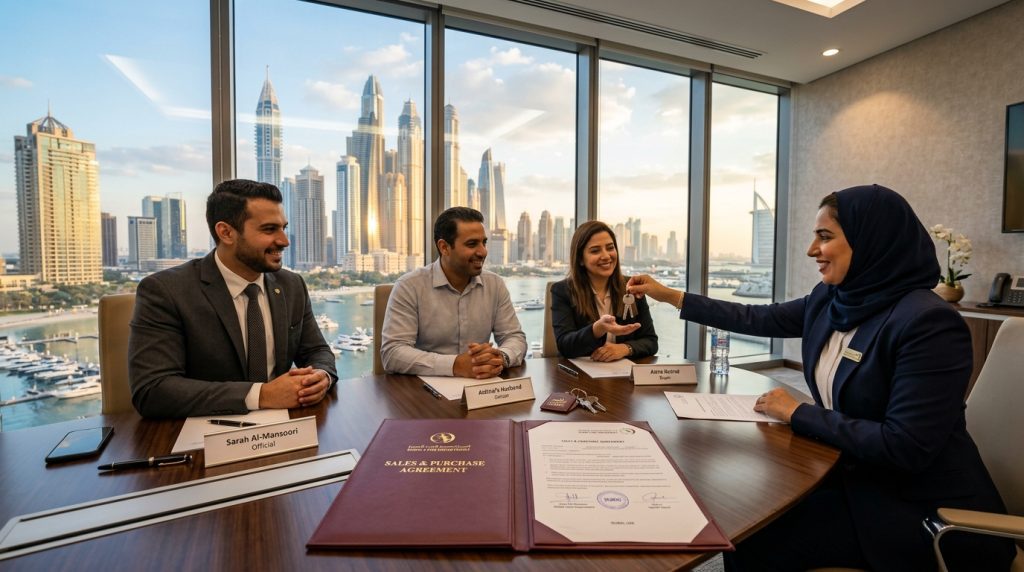
When you accept an offer, the buyer and seller sign a Memorandum of Understanding, called Form F, with the agreed price, the deposit and the transfer date. The buyer typically pays a deposit of 10% of the price, held by the agent or trustee. Both sides are bound once it is signed, so read the clauses on delay and cancellation before you sign.
If the unit is tenanted, the tenancy contract usually continues with the new owner. A landlord who wants vacant possession must give proper notice. Our guide to renting out property in Dubai explains the notice rules.
Step 5: Clear the mortgage and obtain the NOC
Can you sell if you still have a mortgage? Yes. Ask your bank for a settlement letter showing the outstanding balance, and the buyer’s funds can pay it off at the transfer. Banks may charge an early settlement fee, so ask for the exact figure in writing. If the buyer uses their own mortgage, the buyer’s bank issues a manager’s cheque for you and for your lender.
For a unit in a developer-managed project, you also need a No Objection Certificate (NOC) from the developer. The fee varies by developer and is commonly quoted between AED 500 and AED 5,000, so confirm the amount with the developer. The NOC proves that you have paid the service charge and any dues.
Step 6: Transfer the title at the trustee office
The final step takes place at a DLD-registered trustee office. Buyer, seller and agent attend with their documents, the buyer’s payment is made by manager’s cheques, and the DLD issues the new title deed in the buyer’s name. The transfer fee is 4% of the price, and the trustee charges an admin fee, with the buyer paying both in most deals. Agree who pays what in the Form F, since this is negotiable.
Selling costs and fees in Dubai
Cost | Typical amount | Usually paid by |
|---|---|---|
Agent commission | 2% of price plus VAT | Seller or split |
DLD transfer fee | 4% of price | Buyer |
Developer NOC | AED 500 to 5,000 | Seller |
Trustee office fee | About AED 4,000 plus VAT | Buyer or split |
Early mortgage settlement | Set by the bank | Seller |
On a AED 1,500,000 sale, a 2% commission with 5% VAT comes to AED 31,500, and the NOC adds the amount the developer charges. Dubai does not tax property sale profits for individuals, so there is no capital gains tax to pay. Figures are typical, not guaranteed, so confirm each one.
How long does it take to sell a property in Dubai?
Finding a buyer depends on price and demand, and it can take weeks or months. Once a buyer signs the Form F, the NOC, clearances and transfer commonly take a few weeks. A mortgaged buyer takes longer than a cash buyer because the bank needs a valuation. A clean file with a clear service charge account and ready documents saves the most time. If you plan to rent while you wait for a buyer, check how that affects viewings and the sale price.
Tips to sell faster
- Price near the market value of recent sales in your building.
- Clear service charges and collect the NOC documents before listing.
- Stage the home and allow easy viewing times.
- Check the yield your buyer expects, using our guide to rental yield in Dubai, since investors price from rent.
- Pick one agent with experience in your building.
Frequently asked questions
How long does a sale take in Dubai?
After a buyer signs the contract, the NOC, bank steps and transfer commonly take a few weeks. A cash buyer is faster than a mortgaged one. Finding the buyer is the unpredictable part, because it depends on price and demand.
Can I sell my Dubai property if I still have a mortgage?
Yes. Your bank issues a settlement letter, and the buyer’s payment clears the loan at transfer. Ask the bank about early settlement fees and get the figure in writing before you accept an offer.
What documents do I need to sell a property in Dubai?
You need the title deed or Oqood certificate, passports and Emirates IDs, a service charge clearance and the developer NOC. Mortgaged units need a bank letter, and rented units need the tenancy contract.
Who pays the transfer fee when selling property in Dubai?
The DLD transfer fee is 4% of the price, and the buyer normally pays it. Splitting it is negotiable, so write the arrangement into the Form F. The seller usually pays the agent commission and the NOC.
Do I pay tax when I sell property in Dubai?
Individuals do not pay capital gains tax on property sales in Dubai. Your home country may tax the gain, so check with a tax adviser where you are resident.
Prepare the file before you list
Value the property honestly, clear your service charge and agree who pays which fee before you sign. Rules, fees and processes are set by the DLD and developers and can change, so confirm each figure with them. This is general information, not legal or financial advice. If you are also planning your estate, see our guide to a property will in Dubai for expats. Explore more Dubai real estate guides on Live In Gulf.