
Riding the Dubai Metro for the first time is easier than it looks, once you know three things. You need a nol card or a Red Ticket, you tap in and tap out at the gates, and one carriage on every train is for women and children only. This Dubai Metro guide walks you through each of those, with the official RTA fares, the opening hours and the fines that catch newcomers out.
Most people work it out in a day. The trick is not paying fines while you learn.
Dubai Metro Guide at a Glance
Before the detail, here’s the short version. Every figure in this table comes from the Roads and Transport Authority (RTA), which runs the network.
| Item | What you need to know |
|---|---|
| Lines | Red Line (Centrepoint to Expo 2020) and Green Line (e& to Creek) |
| Cards | Red Ticket, Silver, Gold, Personal and nol Travel cards |
| Cheapest fare | AED 3 for one zone on a Silver card |
| Most expensive single fare | AED 15 for three or more zones in Gold Class |
| Hours, Mon to Thu and Sat | 5 am to midnight |
| Hours, Friday | 5 am to 1 am |
| Hours, Sunday | 8 am to midnight |
| Children | Free for ages 5 and under |
| Special cabins | Gold Class, and women and children |
| Coming next | Blue Line, due in 2029 |
Red Line or Green Line: Which One Do You Need?
The Dubai Metro has two lines today, and for most visitors the Red Line does the heavy lifting. It runs from Centrepoint in the east to Expo 2020 in the south-west, passing the airport, the Sheikh Zayed Road towers and the Marina area on the way. It also splits into the Route 2020 branch, which the RTA lists as serving The Gardens, Discovery Gardens, Al Furjan, Jumeirah Golf Estates, Dubai Investment Park and Expo 2020.
The Green Line is shorter and stays in older Dubai, running between e& and Creek through Deira and Bur Dubai. If you want the souks, the creek or the older neighbourhoods, it’s the line you’ll use.
The two lines meet at interchange stations in the centre of the city, where you can switch without tapping out. Check the map at the station or in the RTA Dubai app before you set off, because some stops share similar names.
Two newer links are worth knowing about. The Etihad Rail passenger station at Jumeirah Golf Estates joins the Red Line’s Route 2020 branch by a covered walkway, so you can take the metro to catch a train to Abu Dhabi. And the RTA is building a third line, the Blue Line, which it says will have 14 stations over 30 km and is due in 2029.
Which Nol Card Should You Buy?
A nol card is Dubai’s rechargeable transport card. “Nol” means fare in Arabic, and one card works on the metro, tram, buses and water buses. According to the RTA’s card guide, you have five options:
| Card | Price | What’s included | Good for |
|---|---|---|---|
| Red Ticket | AED 2 | Paper ticket; up to 10 trips or 90 days | A handful of rides |
| Silver | AED 25 | AED 19 credit; valid 5 years | Most visitors and residents |
| Gold | AED 25 | AED 19 credit; Gold Class access at double fare | People who want a seat and space |
| Personal (blue) | AED 70 | AED 20 credit; balance protected if lost | Residents, and anyone eligible for concessions |
| nol Travel | AED 100 | AED 19 credit plus partner discounts | Tourists who want the offers |
So which one? Here’s a quick way to decide, worked out from the RTA fares.
A Red Ticket costs AED 2 up front, then each ride costs AED 1 more than it would on a Silver card. A Silver card costs AED 25, but AED 19 of that is credit you’ll spend on rides, so the card itself really costs you AED 6. That puts the break-even at four trips. Take fewer than four rides and the Red Ticket wins. Take more and the Silver card is cheaper.
Take ten two-zone trips as an example. On a Red Ticket that’s AED 2 plus 10 × AED 6, or AED 62. On a Silver card it’s the AED 6 card cost plus 10 × AED 5, or AED 56. The gap keeps growing the more you ride.
Our view: unless you’re only making a couple of trips, get the Silver card. It also works on buses and the tram, and you won’t hit the Red Ticket’s 10-trip limit halfway through your stay.
The Personal card is worth it for residents. Your balance is protected if you lose it, and it’s the only way to get concession fares if you’re eligible, such as students and some senior citizens. Check the RTA’s current eligibility rules, because the categories are worded slightly differently across its pages.
How Much Does the Dubai Metro Cost?
You pay by zone, not by station. Dubai is split into fare zones, and the price depends on how many you cross. These are the single-journey fares on the RTA’s official fares page:
| Journey | Silver card | Gold card | Red Ticket |
|---|---|---|---|
| Within 1 zone | AED 3 | AED 6 | AED 4 |
| 2 adjacent zones | AED 5 | AED 10 | AED 6 |
| 3 or more zones | AED 7.50 | AED 15 | AED 8.50 |
Longer cross-city rides can pass through three or more zones, so AED 7.50 per trip on a Silver card is a safe number to budget with.
Transfers help too. The RTA allows up to three transfers within 180 minutes on one journey, so switching from the metro to a bus or the tram usually doesn’t mean paying a whole new fare. The RTA’s metro guide also sets a 30-minute limit between legs, so don’t stop for a long coffee in the middle of a transfer.
Children aged 5 and under travel free.
How to Ride the Dubai Metro, Step by Step
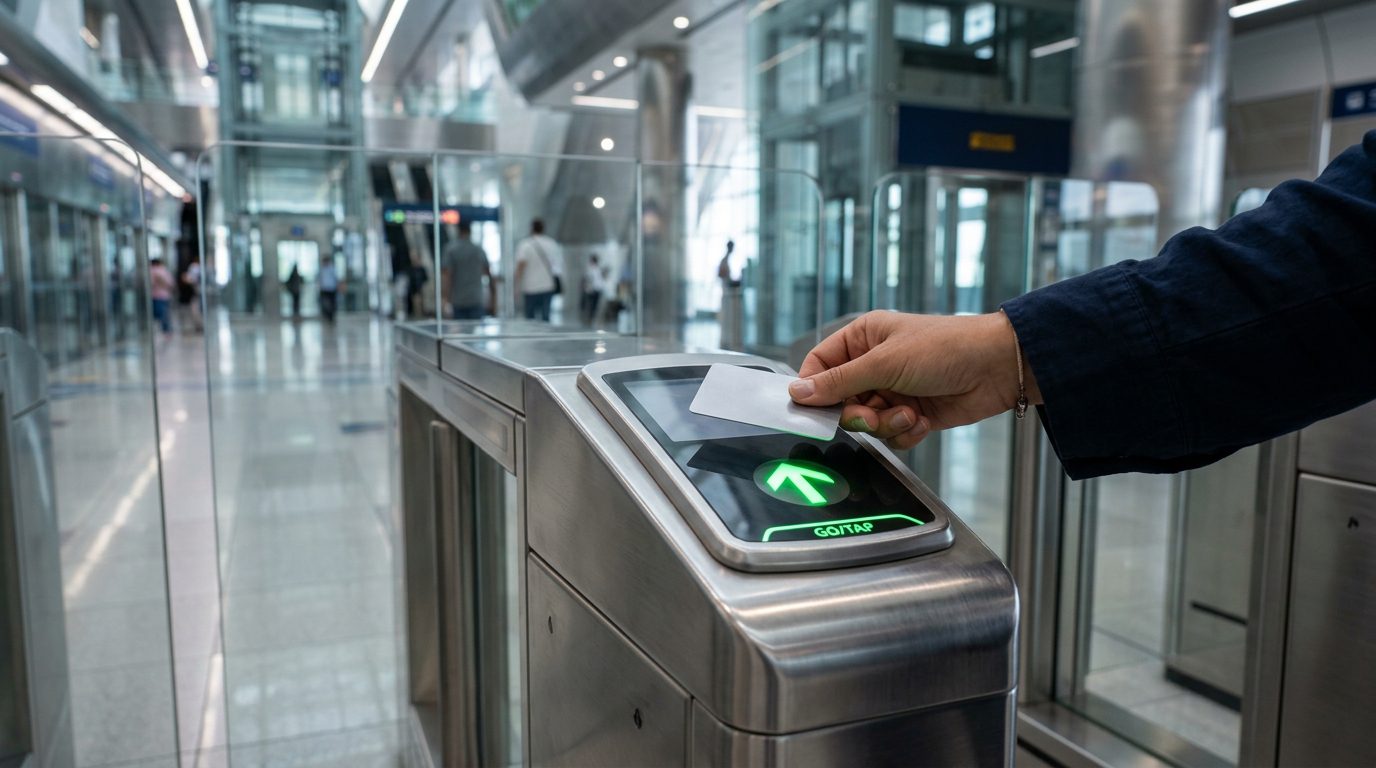
If you’ve used an Oyster card in London or a metro card anywhere else, learning how to use the Dubai Metro will feel familiar. If not, it takes about two minutes.
- Buy your card. Use the ticket office or a vending machine at any station.
- Top up. Add enough credit for your trips. The RTA’s metro guide says you need at least AED 7.50 on the card to pass the gate.
- Tap in. Hold your card on the reader at the entry gate until it opens.
- Find your platform. Follow the line colour (red or green) and the name of the last station in your direction.
- Stand in the right spot. Floor markings show where the Gold Class and women and children cabins stop. Everyone else uses the general cabins.
- Tap out. Tap your card again at the exit gate. This is how the system works out your fare.
If you’re travelling from the airport, the Red Line has stations at Terminal 1 and Terminal 3, so you can buy a card and start straight from arrivals.
What Time Does the Metro Open and Close?
The RTA timetable gives the same hours for both lines:
- Monday to Thursday: 5 am to midnight
- Friday: 5 am to 1 am the next day
- Saturday: 5 am to midnight
- Sunday: 8 am to midnight
Sunday is the one that trips people up. If you’ve got an early flight or a 7 am meeting on a Sunday, the Dubai Metro won’t be running yet, so book a taxi instead.
Hours can change during Ramadan and on public holidays, when the RTA publishes special timings. Check the timetable before any trip that’s tight on time.
Who Can Use the Women’s Cabin?
Every train has a cabin reserved for women and children. The RTA describes these cabins as for women and children only, and men who enter can be fined. The National has reported the fine as AED 100.
You’ll see some guides say a man can ride there if he’s with his wife or family. The RTA’s own description doesn’t say that, so don’t rely on it. If you’re travelling as a couple or a family, the simplest thing is to ride together in a general cabin. Women can use any cabin they like.
What counts as a “child”? The RTA’s guide doesn’t give an age for boys. Young children with their mother are clearly fine. If your son is a teenager, ask station staff before you board.
The cabins are marked on the platform floor and on the train, so it’s hard to walk in by accident if you look down first.
Is Gold Class Worth It?
Gold Class is a separate cabin with wide leather seats and panoramic views, as the RTA describes it. To ride in it, you need a Gold card, and every fare is doubled.
For a single long trip at rush hour, it can be worth the extra AED 7.50. The general cabins between 7 am and 9 am, and again in the evening, can be very full, and Gold Class usually has seats. For daily commuting, the doubled fare adds up fast. Twenty return trips a month at three zones would cost AED 300 more than on a Silver card.
Our position: buy a Silver card for everyday travel and only think about Gold if you’ll use the metro rarely but want comfort when you do. The RTA reserves Gold Class for Gold card holders, so a Silver card won’t get you in, even if you’re willing to pay the difference.
Topping Up and Looking After Your Card
Using the Dubai Metro every day means topping up regularly, and there are a few ways to do it. You can add credit at the ticket office or a vending machine in any station, and the RTA also lets you top up online through its nol services.
There’s a ceiling on how much you can hold. An anonymous Silver or Gold card can carry up to AED 1,000, according to the RTA. Register the card and the limit rises to AED 5,000. For most people that’s far more than they’ll ever need, but registering has a second benefit: if the card has your details on it, you have a better chance of recovering the balance when it goes missing.
That’s where the Personal card comes in for residents. It costs more up front, AED 70 with AED 20 of credit, but it carries your name and the RTA says your balance can be recovered if the card is lost or stolen. Visitors staying a week rarely need it. Someone who tops up AED 200 a month probably does.
All the reusable cards last five years. So if you visit Dubai again next year, keep your Silver card. Any credit left on it is still yours, and you won’t need to pay for a new card.
Rules and Fines to Know
The Dubai Metro is strict, and inspectors do check. These fines are listed on the RTA’s Dubai Metro page:
| Offence | Fine |
|---|---|
| Travelling without a valid ticket or card | AED 200 |
| Eating or drinking in restricted areas | AED 100 |
| Carrying hazardous items or weapons | AED 1,000 |
| Damaging seats or equipment | AED 2,000 |
The eating and drinking rule applies in restricted areas, not only on the train, and that includes a sip of water. Finish your drink before you tap in. Men in the women’s cabin can also be fined, as covered above. Fines can change, so check the RTA page if you’re unsure about something.
Travelling With Children
Families find the Dubai Metro easy to use, with a couple of things to plan for. Children aged 5 and under ride free on every card type, according to the RTA, so a toddler doesn’t need a ticket. From age 6, a child pays the normal fare, so give each older child their own card or Red Ticket, because every person taps through the gate separately.
A mother travelling with young children can use the women and children cabin, which is usually calmer at rush hour. Dads travelling alone with the kids should use a general cabin. Students may be able to get reduced fares on a Personal card, but the RTA sets the eligibility rules, so check them before you apply.
Taking Luggage on the Metro
Yes, you can bring suitcases, which makes the Dubai Metro a cheap way to reach the airport. The RTA allows two bags per person:
- One large suitcase, up to 81 cm × 58 cm × 30 cm
- One small suitcase, up to 55 cm × 38 cm × 20 cm
Keep them in the luggage areas rather than blocking the doors. At rush hour, a big case in a packed carriage is miserable for everyone, you included. If your flight time allows, travel outside 7 am to 9 am and the early evening.
Metro or Taxi: When Is Each One Better?
Riding the Dubai Metro makes most sense for trips along its lines at busy times. Traffic on Sheikh Zayed Road can crawl at rush hour, while the trains keep to their timetable. The fare is fixed too, so you know the cost before you go.
A taxi wins in other cases. If you’re travelling as a group of three or four, sharing a cab can come close to the combined metro fare and saves the walk at each end. Late at night after midnight, or before 8 am on a Sunday, it’s the only option. And if your destination is a long walk from the nearest station, the heat for much of the year makes that walk hard work.
So here’s a simple rule. Use the metro when both ends of your trip are near a station and it’s daytime. Take a taxi when you’re a group, carrying lots of bags, or the station is far from where you’re going.
Mistakes First-Timers Make
Most first-day problems come down to the same handful of mistakes, and avoiding them covers the most useful Dubai Metro tips:
- Forgetting to tap out. The gate needs to read your card on the way out to work out the fare. Walking through an open gate without tapping can leave your trip unpaid, and that’s how people end up with the AED 200 fine.
- Running the balance too low. You can’t pass the entry gate if your balance is below the minimum. Top up before you’re down to a few dirhams.
- Drinking water on the platform. It feels harmless in the heat, but it counts. Drink before you enter.
- Assuming Sunday is a normal day. Trains start at 8 am, not 5 am.
- Buying a Red Ticket for a week-long stay. It runs out after 10 trips and costs more per ride.
- Queuing in the wrong spot. Check the floor markings so you don’t end up at the Gold Class or women’s cabin doors by mistake.
Frequently Asked Questions
How much does the Dubai Metro cost?
On a Silver nol card, a single trip costs AED 3 within one zone, AED 5 across two neighbouring zones and AED 7.50 for three or more. Red Tickets cost AED 1 more per trip, and Gold Class doubles the Silver fare. Children aged 5 and under ride free. These are the RTA’s published fares.
Which nol card should a tourist get?
For more than three or four rides, get the Silver card. It costs AED 25 with AED 19 of credit, so the card itself is AED 6, and each trip is cheaper than on a Red Ticket. Pick the Red Ticket only for a couple of rides, since it runs out after 10 trips.
Can men sit in the women’s cabin on the Dubai Metro?
No. The RTA describes these cabins as for women and children only, and men found there can be fined, reported as AED 100. Some guides say husbands may join their wives, but the RTA doesn’t say so. If you’re travelling as a couple, sit together in a general cabin instead.
What time does the Dubai Metro open on Sunday?
8 am. That’s three hours later than the rest of the week, when trains start at 5 am. The RTA timetable has them running until midnight on Sundays, or 1 am on Fridays. Ramadan and some public holidays bring different hours, so check the RTA before an early trip.
What is the 30-minute rule on the Dubai Metro?
It’s about transfers. The RTA lets you make up to three transfers within 180 minutes on one fare, and its metro guide sets 30 minutes as the limit between legs. Switch from metro to bus or tram within that window and you won’t pay a full new fare.
Your First Ride: Final Dubai Metro Guide Tips
Get a Silver card, keep at least AED 7.50 on it, tap in and tap out, and stand behind the right floor markings. Do those four things and your first week on the metro should be fine-free. If you’re heading further, the new Etihad Rail station connects to the Red Line at Jumeirah Golf Estates, and our guide to the Etihad Rail Dubai station explains how it works.
Planning more of your trip? See our guides to getting from Dubai to Abu Dhabi by train (Etihad Rail) or taxi, spending a 24-hour layover in Dubai and top tourist places to visit in Dubai. You’ll find more in our Dubai travel section and on the Live in Gulf homepage.
Disclaimer: fares, hours and fines are taken from RTA pages and were correct when checked on 29 September 2026. They can change, so confirm on the RTA website or the RTA Dubai app before you travel.