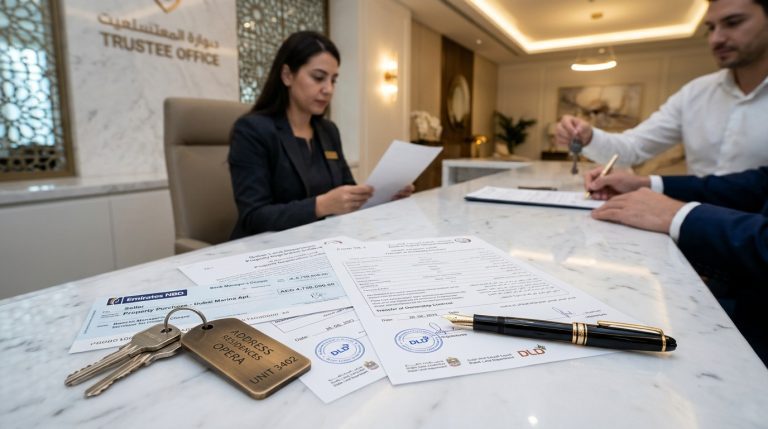
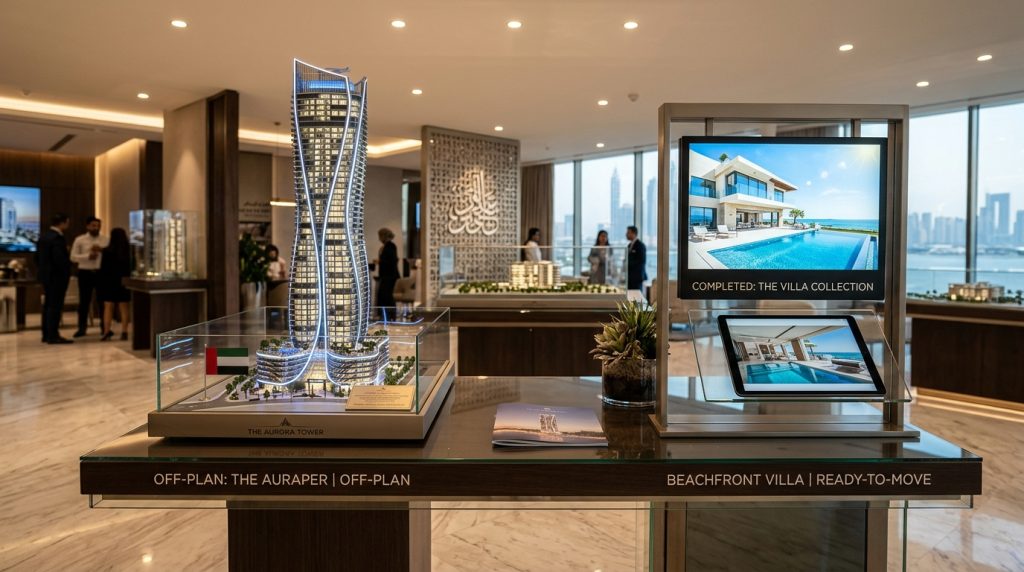
Off-plan vs ready property in Dubai comes down to one trade-off: price and payment flexibility against certainty and income. Off-plan properties are bought from the developer before completion, usually at a lower entry price with flexible payment plans, but you wait one to four years for handover and carry construction risk. Ready properties in Dubai cost more upfront and need the full price at transfer, but you can move in or collect rental income from day one. If you need income or a mortgage now, buy ready. If you can wait and want to spread payments with a payment plan, off-plan can work well with the right developer.
Choosing between off-plan and ready is the first big decision when you buy a property in Dubai. Below is a side-by-side comparison of the differences between off-plan and ready homes, the real costs of each route, the risks people tend to underestimate, and which buyer each option suits. For the full buying process, see our guide to buying property in Dubai.
What Does Off-Plan Property Mean in Dubai?
An off-plan property is a home you buy before it is built, or while it is under construction, directly from the developer. You sign a sale and purchase agreement (SPA), pay a deposit and then pay in instalments linked to construction milestones or set dates. The contract is registered with the Dubai Land Department on Oqood, its interim register for off-plan units, and you receive the title deed at handover.
A ready property, also called a completed property, ready home or secondary-market property, is finished and can be lived in. Most ready units and apartments for sale on the portals are bought from existing owners, though developers also sell ready units in completed projects. The deal is signed on Form F and the title deed transfers on the day you pay.
Off-Plan and Ready Properties: Side-by-Side Comparison
Both property types have a place in Dubai's real estate market, and either can be a sound property investment. This is how they compare on the points that matter most to a buyer or investor.
Factor | Off-plan properties | Ready properties |
Entry price | Often lower than ready properties in the same area | Market price, based on recent sales |
Payment | Instalments over the build, sometimes post-handover | Full price at transfer |
Deposit | Usually 10% to 20% to start | 10% Form F deposit, then the balance |
Mortgage | Max 50% LTV, often only near completion | Up to 80% LTV for a resident's first home |
Rental income | None until handover | Immediate rental income possible |
What you see | Floor plans, renders and a show unit | The actual unit, view and building |
Main risk | Delays, changed specs, market moves before handover | Overpaying, hidden defects, older fittings |
Registration | Oqood, then title deed at handover | Title deed at transfer |
What Off-Plan Properties Offer
• Lower entry price. Developers price early phases below where they expect the finished building to trade, to fund construction and build momentum.
• Flexible payment plans. The off-plan payment plan is the main attraction for many buyers. Common structures include 60/40, 70/30 or 50/50 during construction and on handover, and some developers offer post-handover plans that stretch payments for two to five years after you get the keys.
• Capital appreciation potential. For an investor with a long investment timeline, this is the main draw. If the area develops as planned, the value at handover can be well above the purchase price. That is not guaranteed; it depends on the community and the market cycle.
• New build, new fittings. No previous tenants, modern layouts, and a developer warranty on defects after handover.
• Escrow protection. Under UAE Law No. 8 of 2007, your payments go into a project escrow account and are released to the developer only as construction milestones are verified.
What Ready Properties Offer
Ready properties provide certainty. For buyers who want to live in the home or earn rent quickly, that usually outweighs the higher price.
• What you see is what you get. You inspect the actual apartment, the view, noise levels and the state of the building.
• Immediate rental income or occupancy. You can move in or rent out the property straight after transfer, which improves cash flow from the first month.
• Easier mortgage. Banks lend up to 80% to residents on a first home under AED 5 million, against 50% for off-plan.
• Real data. You can check past property sales, actual rents and service charge history for the building, rather than relying on projections.
• Visa eligibility from day one. A completed property can support a Dubai property visa immediately, while off-plan has extra conditions.
Costs: How the Two Compare
Off-plan and ready properties pay the same 4% Dubai Land Department fee, but at different times. Off-plan buyers pay it when the SPA is registered on Oqood; ready buyers pay it at transfer. Our guide to the DLD transfer fee breaks this down.
The other differences:
• Agency commission: many developers absorb it on off-plan sales; on resale, the buyer usually pays 2% plus VAT.
• Developer promotions: some off-plan launches cover part of the DLD fee or offer service charge waivers for a period.
• Money tied up: off-plan instalments earn nothing during construction. If you are also paying rent elsewhere, count that cost too.
• Snagging and furnishing: a new unit still needs furniture, curtains and appliances, and sometimes fixes at handover.
Risks of Buying Off-Plan (and How to Reduce Them)
The biggest risk is time. Handover dates on Dubai off-plan projects often slip by months, and occasionally by years, so treat any timeline as an estimate. If your plan depends on moving in or collecting rent by a certain date, build in a buffer.
Other risks to weigh:
• Project cancellation is rare with established developers but has happened in past downturns. Escrow rules protect your money, but getting it back can take time.
• Specification changes. The finished unit may differ from the brochure. Read what the SPA allows the developer to change.
• Market timing. The property market moves in cycles. If prices fall before handover, you still owe the agreed price, and the bank's valuation may be lower than your purchase price.
• Walking away is expensive. If you stop paying, the developer can keep a share of what you paid under Dubai's off-plan rules, and that share rises the further construction has progressed.
To reduce these risks, check the developer's delivery record, confirm the project and escrow account on the Dubai REST app, and only pay into the registered escrow account. Our guide to Oqood registration explains how to verify your contract. The Dubai Land Department lists registered developers in Dubai and their projects.
Risks of Buying Ready
Ready properties are not risk-free either. A ready property may look perfect on a viewing and still cost you later. Older buildings may have higher service charges, worn common areas or major works coming up. The unit may have hidden defects behind fresh paint. And in a rising market, you pay today's full price with no early-bird discount. Ask for the service charge history, inspect the unit with a snagging company if the building is older, and compare the asking price with recent sales on the DLD's records.
Off-Plan vs Ready Property for Investors
For an investor, the question is less about the home and more about return and risk over a set investment timeline. Ready properties offer a known rent from the start, so the yield is easy to calculate and the property pays its way while you hold it. Off-plan properties offer capital appreciation potential instead: you commit a smaller amount early and hope the value rises by handover.
Which works better depends on the Dubai real estate market at the time you buy. In a rising market, off-plan investors who bought at launch have often done well on paper. In a flat or falling market, ready properties in Dubai with steady tenants tend to hold up better, because the rent keeps coming in even if prices pause. Our view: an investor who needs the property to cover its own costs should buy ready; one with spare cash and a long horizon can consider off-plan from a strong developer.
Also think about liquidity. A ready apartment for sale in Dubai in an established tower has a deep pool of buyers and tenants. A resale off-plan unit competes with the developer's own remaining stock, which can make it harder to sell before handover.
Can I Sell My Off-Plan Property Before Handover?
Yes, in most cases. Selling before completion is called an assignment, and it is a common off-plan real estate strategy for investors. Most developers only allow it once you have paid a set percentage of the price, often around 30% to 40%, and they charge a fee for the NOC. The new buyer pays a fresh 4% DLD fee on the transaction. Check the resale clause in your SPA before you buy, because some developers restrict early resales.
Which Should You Choose? Our View
Ready properties offer the most for buyers who want certainty. Choose a ready property if you want to live in it soon, need rental income to cover a mortgage, rely on bank financing, or want a property visa now. For most first-time buyers living in Dubai, ready properties are the safer option.
Choose off-plan if you have the cash to cover instalments without a mortgage, can wait two to four years, are buying from a developer with a strong delivery record, and are comfortable with some market risk in return for a lower entry price and spread payments. Off-plan properties may also suit buyers who want a new home in a specific master community that has nothing ready yet.
It depends on your situation, and the community matters as much as the choice of route. An off-plan unit in an established area such as Downtown Dubai or Dubai Marina carries different risk from a launch in an emerging district such as parts of Dubai South, where the infrastructure is still years away. The same applies to luxury properties, where resale demand is thinner. Compare actual rental yields in our rental yield by area guide before you decide.
Frequently Asked Questions
Is it worth buying off-plan in Dubai?
It can be, if you buy from a reliable developer, in a well-located community, and can afford the instalments without strain. Off-plan offers lower entry prices and flexible payment plans. The trade-off is waiting for handover, no rental income during construction, and the risk of delays or a market dip before completion.
What is cheaper, off-plan or ready property?
Off-plan is usually priced lower than ready properties at the point of purchase, and payments are spread over the build. Ready property often costs more per square foot but starts earning rent immediately. Once you include the rent you pay elsewhere while waiting and the money tied up in instalments, the gap narrows.
Can I get a mortgage on off-plan property in Dubai?
Yes, but banks lend a maximum of 50% of the value on off-plan, and many only lend close to completion. Most buyers pay construction instalments in cash and take a mortgage for the handover payment. Ready properties qualify for higher loans. See our mortgage in Dubai for expats guide.
How long does off-plan handover take in Dubai?
Most off-plan projects quote two to four years from launch to handover, depending on the building's size. Delays of several months are common, so check the developer's track record and read the SPA clause on the anticipated completion date and any compensation if the project runs late.
Off-Plan vs Ready Property: Final Checklist
Use this list to compare off-plan and ready options for your situation:
• Do you need to move in or earn rent within a year? Choose ready.
• Do you need a mortgage above 50%? Choose ready properties.
• Can you pay instalments from savings for two to four years? Off-plan is an option.
• Has the developer delivered similar projects on time? If not, think again.
• Is the project registered with escrow on Dubai REST? It must be.
Whichever you choose, check that the community is a freehold area open to foreign buyers. Our list of freehold areas in Dubai is the place to start.