Buying property in Dubai as a foreigner is legal, fast and fully registered with the government, as long as you buy in a designated freehold area. You can own an apartment, villa or townhouse outright, in your own name, with no local partner. A cash resale deal typically completes in two to four weeks (four to ten weeks with a mortgage), and the main government cost is the Dubai Land Department (DLD) transfer fee of 4% of the price. Budget roughly 6.5% on top of the purchase price for a cash purchase, or 7% to 8% with a mortgage.
That is the short answer. This step-by-step guide covers the whole buying process in the order it happens: the documents you need at each stage, what it really costs, and the mistakes we see buyers make most often. Whether you want to buy a house in Dubai to live in or hold an apartment for investment purposes, the legal framework is the same.
Can Foreigners Buy Property in Dubai? The Ownership Rules
Yes. Since 2002, non-UAE nationals have been allowed to buy freehold property in specific parts of the emirate, and Dubai Law No. 7 of 2006 on real property registration put those rights on a formal legal footing. Freehold means you own the unit and your share of the property and land beneath it, with no time limit. Understanding the legal framework matters because it decides what you can do with the home later. As the property owner, you can sell the property, lease the property to tenants, mortgage it or leave it to your heirs.
Outside freehold zones, foreigners can usually only take a leasehold interest, which is a long lease of up to 99 years. For most international buyers purchasing property in Dubai, leasehold is not worth the complication.
You do not need a residence visa to buy and own property here. A valid passport is enough for a cash purchase, and our guide on whether foreigners can buy property in Dubai covers the rules for non-residents in detail. Residency becomes relevant later, if you want a mortgage on better terms or want your property to support a Dubai property visa.
Popular freehold areas in Dubai
Freehold zones cover most of the communities that come up in any property search, from waterfront towers to family villa communities. A few of the best-known are below; our full list of freehold areas in Dubai covers the rest.
• Dubai Marina and JBR: waterfront apartments, strong rental demand, walkable to the tram and metro.
• Downtown Dubai: Burj Khalifa and Dubai Mall on the doorstep, higher prices per square foot.
• Palm Jumeirah: premium villas and branded apartments, the top end of the market.
• Dubai Hills Estate and Arabian Ranches: family villas and townhouses with parks and schools.
• Business Bay and Dubai Creek Harbour: newer towers, many off-plan projects.
• JVC, Discovery Gardens and Dubai South: lower entry prices and higher rental yields.
Before you pay anything, confirm the exact building sits in a freehold zone. Your agent should show this, but you can also check the unit on the Dubai REST app.
Ready vs Off-Plan: Decide This First
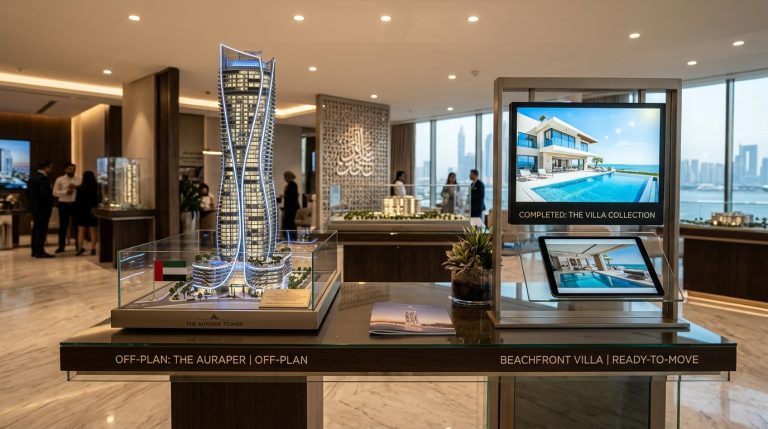
Every other decision follows from this one. A ready (secondary or resale) property is finished and you buy it from the current owner. An off-plan property is bought from the developer before or during construction.
Ready / resale | Off-plan | |
Who you buy from | Current owner | Developer |
Contract | Form F (MOU) | Sale and Purchase Agreement (SPA) |
Registration | Title deed at transfer | Oqood (interim register), title deed at handover |
Payment | Full price at transfer | Instalments into a RERA escrow account |
Mortgage | Widely available | Limited until near completion |
Rental income | From day one | Only after handover |
Main risk | Paying too much, hidden defects | Delays, quality on handover |
Our view: if you need rental income or a mortgage, ready property is the safer buy. Our detailed comparison of off-plan vs ready property goes through the trade-offs. Off-plan suits buyers who have cash to spread over two to four years and can live with the possibility of delays. Under UAE Law No. 8 of 2007, developers must put buyers' payments into a project escrow account and can only draw them down as construction milestones are verified, which protects your money but does not guarantee a completion date.
The Buying Process: How to Buy Property in Dubai Step by Step
This is the process for a resale apartment or villa, which is how most residents and investors enter Dubai's property market. The process of buying a property off-plan is different, and we cover it further down.
Step 1: Set your budget, including fees
Work out the total, not just the asking price. On top of the price, you will pay the 4% DLD fee, trustee and title deed charges, usually a 2% agency commission plus VAT, and mortgage costs if you borrow. An AED 1.5 million apartment needs roughly AED 96,000 in costs if you pay cash, and about AED 105,000 to AED 115,000 with a mortgage.
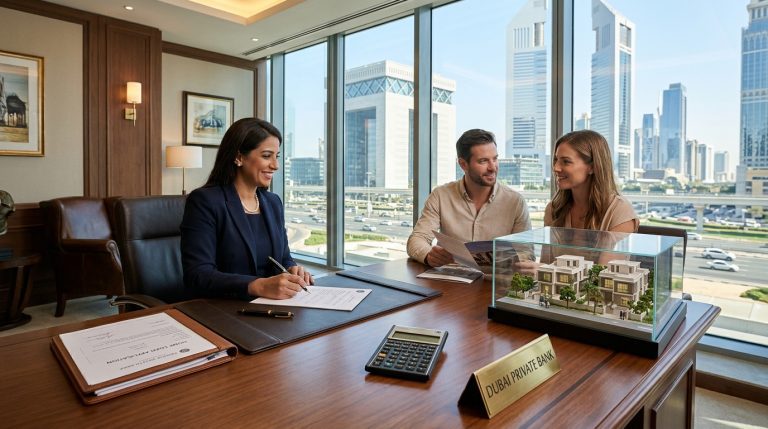
Step 2: Get mortgage pre-approval (if borrowing)
If you plan to finance the purchase, get a pre-approval from a UAE bank before you make an offer. It tells you exactly how much you can borrow and makes your offer more credible. Run your numbers first with our Dubai mortgage calculator. Pre-approvals are valid for a limited period, often 60 to 90 days, so time it with your search.
Step 3: Choose a licensed real estate agent
Agents in Dubai must be licensed by the Real Estate Regulatory Agency (RERA), the regulatory arm of the Land Department. Ask for the broker's BRN (Broker Registration Number) and check it on the Dubai REST app. An experienced real estate agent who works one community every day will also know which buildings have problems. An unlicensed "agent" cannot legally prepare your Form F and gives you no recourse if something goes wrong.
Step 4: Check the property and the seller
Before making an offer, ask for a copy of the title deed and confirm the seller's name matches their passport. Our guide to the title deed in Dubai shows how to verify it online. Check whether there is a mortgage on the property, because the seller must clear it before transfer. Also look at the building's service charges, which vary widely from one community to the next and are approved per building by RERA.
Step 5: Sign Form F, the memorandum of understanding
Once the price is agreed, buyer and seller sign Form F, the standard MOU issued by the regulator. It records the price, the transfer date, who pays which fees, and the deposit. The buyer normally hands the agent a 10% security deposit cheque, held until transfer. The contract is binding. If the buyer pulls out without a valid reason, the seller can usually keep the deposit. Read our guide to Form F in Dubai before you sign.
Step 6: Seller obtains the no objection certificate
The seller applies to the developer for the NOC. It confirms that all outstanding service charges have been paid and that the developer has no objection to the sale. NOC fees typically range from AED 500 to AED 5,000 depending on the developer, and the seller normally pays.
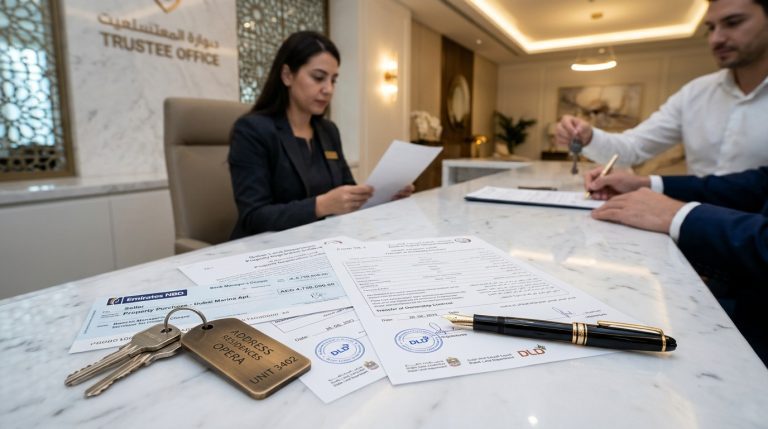
Step 7: Transfer at a trustee office
On transfer day, buyer and seller (or their representatives with a power of attorney) meet at a registration trustee's office approved by the Dubai Land Department. The buyer brings manager's cheques for the seller and for the government fees. The trustee processes the transfer and the new title deed is issued in your name, usually electronically on the same day.
Property Prices in Dubai: What Your Budget Buys
Property prices in Dubai vary more by community than by city-wide trend. An average price figure for "Dubai" hides a huge spread: a studio in an outer community and a villa on Palm Jumeirah are effectively different markets. Two things set the price per square foot more than anything else, namely location and whether the building is ready or off-plan.
As a rough guide to how the market is tiered:
• Entry level: studios and one-bedroom apartments in JVC, Dubai South, Discovery Gardens and International City. This is where the lowest apartment prices in Dubai sit, and often the highest gross yields.
• Mid-market: one- to three-bedroom apartments in Business Bay, Dubai Marina and Dubai Hills, plus townhouses in newer villa communities.
• Prime: Downtown Dubai, Palm Jumeirah, Emirates Hills and branded residences, where property sizes are larger and prices per square foot are highest.
Do not rely on asking prices on listing portals. Real estate prices actually achieved are published through the Land Department's transaction data and the Dubai REST app, and they are often below what sellers advertise. Look at factors such as property age, view, floor, and parking as well as size when you compare.
Where to Find Dubai Real Estate for Sale
Most people looking to buy properties start on the big portals, Bayut, Property Finder and Dubizzle, which carry most apartments for sale and villas for sale from licensed agencies. Use them to find properties for sale and get a feel for the average property in each community, then verify the details independently. Every legitimate listing should show a valid permit number issued by the regulator, and you can scan it to confirm the property for sale is genuine and the agent is licensed.
For off-plan, developers such as Emaar, Nakheel, DAMAC and Sobha sell directly as well as through agents. If you are interested in buying a new launch, compare the same unit type through the developer and a broker, because promotions differ.
What Documents Do You Need to Buy Property in Dubai?
For a cash purchase, the paperwork is lighter than most buyers expect.
• Valid passport (original and copy)
• Emirates ID, if you are a UAE resident
• Signed Form F (resale) or SPA (off-plan)
• Developer NOC (resale)
• Manager's cheques for the seller, the government fees and the trustee
• Power of attorney, if someone attends the transfer on your behalf
Mortgage buyers also need salary certificates or audited accounts, six months of bank statements and a bank-arranged property valuation. Non-residents are usually asked for proof of income from their home country and 12 months of international bank statements.
How Much Does It Cost to Buy Property in Dubai?
Here is the typical fee stack for a ready property. Figures are based on the Land Department's published fee schedule and standard market practice, so check the latest rates before you transfer.
Cost | Typical amount | Usually paid by |
Dubai Land Department transfer fee | 4% of price | Buyer |
Title deed issuance | About AED 580 | Buyer |
Trustee office fee | AED 4,000 + VAT (AED 2,000 + VAT under AED 500,000) | Buyer |
Agency commission | 2% of price + 5% VAT | Buyer |
Mortgage registration | 0.25% of loan + AED 290 | Buyer (if financed) |
Bank valuation | AED 2,500 to AED 3,500 | Buyer (if financed) |
Bank arrangement fee | Up to 1% of loan + VAT | Buyer (if financed) |
Developer NOC | AED 500 to AED 5,000 | Seller |
Our guide to the DLD transfer fee explains who pays the 4% and how to pay it.
Worked example: an AED 1,500,000 apartment bought with cash. The 4% fee is AED 60,000, the agency commission is AED 30,000 plus AED 1,500 VAT, and the trustee and title deed add about AED 4,800. Total costs: roughly AED 96,300, or about 6.4% of the property value. Add a mortgage and you can expect another 1% to 1.5% of the loan.
Dubai does not charge capital gains tax on a resale for individual owners, and there is no yearly tax on the property itself. You will still pay yearly service charges, plus the Dubai housing fee on your DEWA bill if you live in the home. Our guide to the cost of owning property in Dubai breaks down every recurring charge.
Getting a Mortgage as a Foreign Buyer
Banks in Dubai lend to residents and, more cautiously, to non-residents. The UAE Central Bank sets maximum loan-to-value (LTV) limits, and banks can lend less but never more. For an expatriate resident buying a first home worth AED 5 million or less, the cap is generally 80%, so you need at least a 20% down payment, plus the fees above in cash. Above AED 5 million, the LTV drops.
Non-residents face stricter terms. The Central Bank does not set a separate non-resident cap, but in practice banks usually lend 50% to 65% of the value and want a higher minimum income. Home loan rates track the EIBOR benchmark, so fixed-rate periods typically last one to five years before switching to a variable rate.
Two things depend on the bank and change often: minimum salary requirements and the maximum age at the end of the loan term. Check both directly with two or three lenders, or use a broker. Our guide to the mortgage in Dubai for expats covers eligibility, documents and fees.
Buying Off-Plan: How the Process Differs
Off-plan purchases skip the MOU and the developer NOC. Instead:
1. Verify the developer and project on the Dubai REST app, including the RERA project number and escrow account.
2. Pay a booking deposit, usually 5% to 20% of the price, into the escrow account.
3. Sign the SPA with the developer.
4. Pay the 4% registration fee so the contract is recorded on Oqood, the interim register for off-plan units.
5. Pay instalments as construction progresses.
6. Inspect the unit at completion (snagging), pay the final balance and receive the title deed.
Many developers absorb the agency commission on off-plan sales, and some run promotions that cover part of the registration fee. Compare off-plan projects on the developer's delivery record, not just the payment plan. Read the SPA carefully for the anticipated completion date and what compensation, if any, applies if the project runs late.
First-Time Buyer? Check the DLD Programme
The Dubai Land Department and the Department of Economy and Tourism launched the First-Time Home Buyer Programme in July 2025. It is open to UAE residents of any nationality aged 18 or over who do not already own freehold residential property in Dubai, buying a home valued below AED 5 million. Benefits include priority access to new launches and preferential prices from participating developers, plus better mortgage terms from partner banks. Registration is through the Dubai REST app or the DLD website.
Non-residents cannot use the programme, so it mainly helps tenants who already live and work in the UAE.
Does Buying Property Get You a UAE Visa?
It can. Property ownership can support a two-year investor visa, and a property worth AED 2 million or more can qualify you for the 10-year residence route. The rules on mortgaged, jointly owned and off-plan property differ, so read our guide to the Golden Visa through property before you choose a price point, because the AED 2 million threshold has its own conditions.
Common Mistakes Foreign Buyers Make
Most problems we hear about come from a handful of avoidable errors.
• Budgeting only for the price. Buyers who forget the 6.5% to 8% in fees end up scrambling for cash in the week before transfer.
• Signing Form F before mortgage approval. If the bank's valuation comes in low, you have to cover the gap or risk losing your 10% deposit. Add a finance clause to Form F.
• Ignoring running costs. A tower with a long amenity list can eat a big slice of your returns. Check the official service charge index for the building.
• Paying a developer's private account. Off-plan money should only go to the registered project escrow account.
• Trusting headline rental yields. Agents often quote gross yields. After service charges, vacancy and maintenance, net returns are noticeably lower. Compare real figures in our rental yield by area guide.
One more: if you are buying from abroad and cannot attend transfer, sort out a power of attorney early. A POA signed outside the UAE needs to be notarised and attested, which can take several weeks.
Is Buying Property in Dubai Worth It?
For many buyers, yes, but not for everyone. The case for it is strong. There is no annual property tax, the registration system is transparent, established communities still show strong rental yields, and ownership can support residency. That combination is why Dubai keeps attracting real estate investment from buyers who want a home, an income or both. The risks are real too. Prices move in cycles, oversupply can hit specific communities, and off-plan projects can run late.
Our honest take: buy in a well-established community, plan to hold for at least five years, and choose ready property if you need the income. It also depends heavily on the building, so compare service charges and recent residential property sales on the Land Department's records rather than relying on asking prices.
Frequently Asked Questions
How much money do I need to buy a property in Dubai?
For a cash purchase, budget the full price plus about 6.5% for the DLD fee, agency commission and admin charges, or 7% to 8% if you also take a mortgage. With a mortgage, an expat resident needs at least 20% of the value as a down payment on a first home under AED 5 million, plus those same fees in cash.
Can I buy property in Dubai without living in the UAE?
Yes. Non-residents can buy freehold property with just a passport, and the transfer can be completed through a power of attorney if you cannot travel. Mortgages are available to non-residents from some UAE banks, but expect a larger deposit, often 35% to 50%, and stricter income checks.
How long does it take to buy a property in Dubai?
A cash resale purchase usually takes two to four weeks from signing Form F to transfer. With a mortgage, allow four to ten weeks because of bank approval, valuation and the seller's mortgage release. Off-plan purchases register within days, but handover can be years away.
Is there a property tax in Dubai?
No. Dubai has no annual property tax and no capital gains tax on residential property for individuals. The main one-off cost is the 4% DLD transfer fee. Owners pay yearly service charges, and whoever lives in the home pays a housing fee through the DEWA bill.
Can I buy property in Dubai without an agent?
You can, especially when buying off-plan directly from a developer. For resale, going without a RERA-licensed agent saves the 2% commission, but you then handle Form F, the NOC and trustee booking yourself. Many buyers who skip the agent hire a conveyancer instead.
Your Next Steps Before Buying Property in Dubai
If you take one thing from this guide to buying, let it be the order of decisions. Start with your total budget and, if you need finance, a mortgage pre-approval. Shortlist two or three freehold communities, check running costs and recent sale prices, and only work with a licensed agent. When you are close to a deal, read the MOU line by line, especially the clauses on deposit, finance and fees.
Once you own the home, the next questions are usually about running costs, renting it out and, one day, selling it. Our guide to selling property in Dubai covers the exit, from listing to the final transfer. For the official rules, the Dubai Land Department and the UAE Central Bank rulebook are the primary sources.
This guide is general information, not legal or financial advice. Fees and lending rules change, so confirm current figures with the Land Department, your bank and a qualified property lawyer before you commit.